
How to Ignore Distracting Thoughts So You Can Focus on What Matters Most
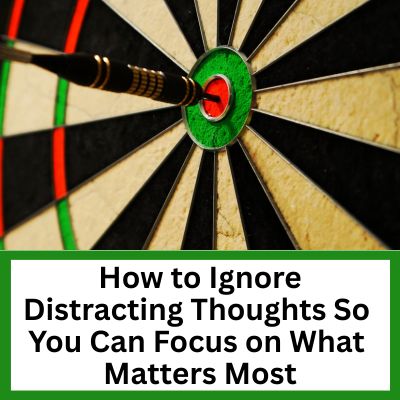
How to Ignore Distracting Thoughts So You Can Focus on What Matters Most
When people think about getting organized, they usually picture closets, pantries, or overflowing garages.
But one of the biggest obstacles to getting organized isn’t physical clutter—it’s mental clutter.
Every day we’re bombarded with distractions. An email pops into our inbox. Someone makes an offhand comment that we can’t stop replaying. We remember something we forgot to do. We start organizing a closet and suddenly find ourselves researching storage bins online. Before we know it, we’ve spent an hour thinking about everything except the task we intended to accomplish.
I’ve been thinking about this a lot lately in my own life. As President of a nonprofit art association, there are always dozens of things competing for my attention. Some deserve my focus. Others are simply distractions disguised as urgency.
One of my teachers, Herrieta Obriko, has taught me a great deal about metacognition—the practice of becoming aware of our own thinking. She has given me a simple framework that has helped me organize not just my home, but my attention.
Whenever I find myself mentally stuck, I ask:
What is the thought that’s distracting me?
Once I identify it, I ask a second question:
Is there anything I can actually do about it?
If the answer is yes, then the next step is simple:
Do the thing.
Make the phone call.
Write the email.
Schedule the appointment.
Have the conversation.
Take one concrete action.
Action often quiets our minds far better than overthinking ever will.
But if the answer is no…
If I’ve already had the conversation.
Already made the decision.
Already explained myself.
Already done my best.
Then continuing to give that thought my attention isn’t helping me move forward.
That’s when Herrieta encourages me to do something beautifully simple:
Let it go. Then return to joy.
I love that phrase because it reminds me that my attention is a choice.
Not Every Thought Deserves Equal Attention
One of the biggest lessons I’ve learned is that just because a thought enters your mind doesn’t mean it deserves your time.
Whenever something begins pulling at my attention, I ask myself four questions:
- Is this actually my responsibility?
- Will giving this more attention change the outcome?
- What happens if I simply let this thought pass?
- What am I giving up by focusing on this instead of what matters most?
That last question has become one of the most powerful.
Every hour spent replaying a conversation, worrying about someone else’s opinion, or mentally arguing with a situation that can’t be changed is an hour I’m not spending creating, organizing, connecting with loved ones, or doing work that truly makes a difference.
Our attention is limited.
Every distraction comes with an opportunity cost.
Organizing Your Attention
Professional organizing isn’t just about reducing physical clutter.
It’s also about reducing mental clutter.
When we learn to recognize distracting thoughts, decide whether action is needed, and then intentionally redirect our attention, we become calmer, more productive, and better able to focus on what truly matters.
So the next time a thought keeps pulling you away from what you’re trying to accomplish, pause and ask yourself:
Is this asking for action, or is it simply asking for my attention?
If action is needed, do the thing.
If there’s nothing more to do, let it go.
Then return to joy.
Because organizing your mind may be one of the most important organizing projects you’ll ever complete.

Posted By Jean Prominski, Certified Professional Organizer
- Follow me on Instagram @seattlesparkle
- Join my Facebook Group, Declutter and Organize with Seattle Sparkle.
- Ready to book a consultation? Complete this form.