
A Brief History of Consumerism… and Why So Many of Us Feel Buried by Stuff
When people struggle with clutter, disorganization, or overflowing storage spaces, it is easy to assume the problem is simply “too much stuff” or a lack of discipline. But the reality is far more complex. Our relationship with possessions has been shaped by generations of cultural change, advertising, economic shifts, and emotional conditioning.
Modern consumerism did not happen overnight.
For most of human history, people owned relatively little. Clothing was repaired repeatedly. Furniture was built to last. Tools were shared among families and communities. Many items were handmade or difficult to acquire, so possessions carried both practical and emotional value. Shopping was largely necessity-based rather than identity-based.
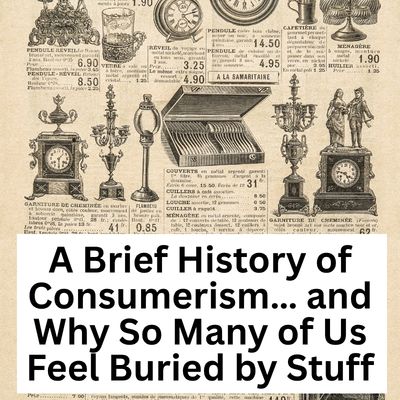
That began to change dramatically in the late 1800s with the rise of mass manufacturing and mail-order retail.
Companies like Sears Roebuck and Montgomery Ward revolutionized shopping in America through massive catalogs that brought consumer goods directly into rural homes. Families who had once been limited to whatever was available locally could suddenly order fashionable clothing, kitchen gadgets, furniture, toys, and even entire house kits by mail.
The catalog became more than a shopping tool. It became a window into aspiration.
People were no longer simply buying what they needed. They were buying ideas about what life could look like.
By the early and mid-1900s, department stores, national advertising campaigns, installment payment plans, and mass production accelerated the shift even further. Consumer goods became tied to status, modernity, success, and self-expression.
After World War II, consumerism became deeply embedded in the American Dream. Owning a home filled with modern conveniences symbolized stability and achievement. Advertisements increasingly suggested that happiness, beauty, belonging, and even love could be purchased.
Television advertising in the 1950s and beyond amplified this messaging dramatically.
Shopping evolved from:
“Buy what you need”
to:
“Buy what represents who you are.”
Over time, planned obsolescence and fast-changing trends normalized constant replacement. Products were no longer designed primarily for longevity. New versions, new colors, new collections, and new technologies encouraged perpetual upgrading.
Then came the internet.
Online shopping, targeted advertising, influencer culture, social media algorithms, and one-click purchasing removed nearly every barrier between impulse and acquisition. Today, people are exposed to thousands of advertisements and product messages every single day. Shopping is no longer an occasional activity. It is woven into entertainment, identity, coping mechanisms, and even social connection.
And yet, our nervous systems have not evolved nearly as quickly as our consumption culture has.
Many people inherit not only physical belongings from previous generations, but also inherited beliefs:
- Keep it “just in case.”
- Waste is bad.
- Sales mean savings.
- More possessions equal security.
- Success should look visible.
- Sentimental objects preserve memories.
- Productivity requires endless tools and supplies.
At the same time, modern life often leaves people overwhelmed, exhausted, emotionally depleted, and searching for comfort or dopamine. Purchasing something new can temporarily soothe stress, boredom, loneliness, grief, or uncertainty.
This is one reason organizing is rarely just about “getting rid of stuff.”
Our homes often become physical archives of our identities, aspirations, fears, memories, unfinished projects, and emotional coping patterns. Clutter is frequently connected to deeper psychological and cultural systems, not laziness or failure.
Understanding the history of consumerism can help reduce shame.
Most people were never taught how to navigate a world specifically designed to encourage constant accumulation. Entire industries depend on convincing us that we are lacking something and that fulfillment can be purchased.
The goal of organizing is not deprivation.
It is intentionality.
It is learning to separate genuine value from marketing pressure. It is creating homes that support our actual lives rather than homes that serve as storage units for guilt, fantasy selves, impulse purchases, or inherited expectations.
When we begin to understand how consumer culture shaped us, we can start making more conscious choices about what we bring into our homes, what we hold onto, and what truly deserves space in our lives.
This week, before bringing something new into your home, try pausing long enough to ask:
- What problem am I hoping this purchase will solve?
- Do I already own something similar?
- Am I buying this from intention, boredom, stress, insecurity, or aspiration?
- Will this item genuinely improve my daily life, or simply add more noise to it?
Then choose one small area of your home and take inventory of what is already there.
Use the candle.
Wear the nice outfit.
Read the book.
Finish the project.
Cook the food.
Plant the seeds.
Consumer culture constantly teaches us that fulfillment is waiting in the next purchase.
But often, peace is found in reconnecting with what we already have.

Posted By Jean Prominski, Certified Professional Organizer
- Follow me on Instagram @seattlesparkle
- Join my Facebook Group, Declutter and Organize with Seattle Sparkle.
- Ready to book a consultation? Complete this form.