
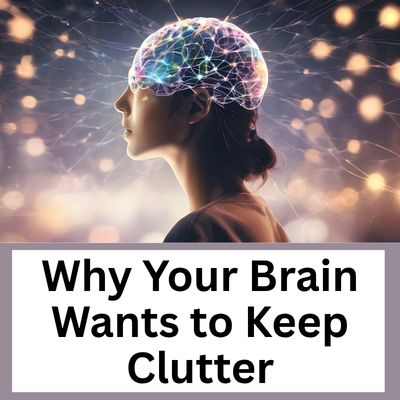
Why Your Brain Wants to Keep Clutter
If you’ve ever tried to get organized and found yourself stuck in the same patterns, it can feel frustrating.
You clear a space.
You make a plan.
You want things to be different.
And then somehow… things drift back.
The same piles.
The same habits.
The same resistance to letting things go.
It’s easy to think this is a motivation problem.
But often, it’s not.
It’s your brain.
The Part of Your Brain That Likes Things the Same
There’s a part of your brain called the limbic system.
Its job isn’t to make your life perfectly organized or efficient.
Its job is to keep you safe.
A key player here is the amygdala, which scans for potential threats and uncertainty.
And one of the ways your brain reduces perceived risk is by preferring what’s familiar.
Not what’s best.
Not what’s most functional.
Just… what’s known.
Because familiar requires less energy, less decision-making, and less risk.
Familiar Feels Safe (Even When It Isn’t Ideal)
From your brain’s perspective:
- That overflowing drawer? Familiar.
- That stack of papers you’ve been meaning to deal with? Familiar.
- That closet full of things you don’t wear? Familiar.
And familiar registers as:
“We’ve survived this before. Let’s keep it.”
Even if it’s:
- inefficient
- frustrating
- or quietly draining your energy
Your brain isn’t evaluating quality.
It’s recognizing patterns stored in the basal ganglia, the part of your brain responsible for habits.
If something has been repeated enough times, your brain treats it as the default.
Why Change Feels So Uncomfortable
When you start to organize, you’re not just moving objects.
You’re interrupting established neural pathways.
And that requires effort.
Your prefrontal cortex—the part of your brain responsible for planning and decision-making—has to step in.
But it tires quickly.
That’s why organizing can feel mentally exhausting.
And why your brain tries to hand things back over to habit as quickly as possible.
Even small changes can trigger resistance:
- Deciding where something “should” go
- Letting go of something you’ve held onto
- Creating a new system you’re not used to yet
That discomfort isn’t a sign you’re doing it wrong.
It’s your brain saying:
“This requires more energy. Let’s go back to what’s easier.”
Why Letting Go Can Feel Emotional
There’s also a chemical component.
When you hold onto something familiar—even if it’s not useful—your brain can release small amounts of dopamine, reinforcing the behavior.
Letting go, on the other hand, can feel like a loss.
Not just emotionally, but neurologically.
Your brain interprets it as:
“We’re giving something up. Are we sure that’s safe?”
That’s why even small decisions can feel disproportionately hard.
The Same Pattern Shows Up Everywhere
Once you understand this, you start to see it beyond your home.
The limbic system doesn’t just influence your stuff.
It influences:
- your routines
- your relationships
- your decisions
We often stay in:
- habits that don’t serve us
- dynamics that feel draining
- environments that aren’t quite right
Not because they’re good…
But because they’re familiar—and therefore feel safe.
Why “Just Get Rid of It” Doesn’t Work
This is why forcing change rarely sticks.
If you try to override your brain with:
- big purges
- strict rules
- all-or-nothing thinking
…it often backfires.
Because your brain experiences that as a spike in cognitive load and stress.
And when that happens, it looks for relief.
Fast.
That’s when you see:
- burnout
- decision fatigue
- things slowly returning to how they were
Working With Your Brain (Not Against It)
Instead of forcing change, it’s more effective to work with how your brain operates.
- Make changes small and repeatable
Small changes don’t trigger as much resistance.
They allow your brain to build new pathways gradually.
- Keep what feels supportive
When something genuinely works, your brain begins to register it as safe.
That’s how new habits take hold.
- Build familiarity with better systems
The goal isn’t just to create a better space.
It’s to create a space your brain recognizes as normal.
Repetition rewires the brain.
What once felt unfamiliar becomes automatic.
A Different Way to Think About Organization
Getting organized isn’t just about willpower.
It’s about gently retraining your brain.
Helping it learn:
“This works better. And it’s safe to stay here.”
Over time, your brain stops resisting…
…and starts supporting the change.
A Simple Place to Start
Pick one small area.
Not to overhaul it completely—but to adjust it slightly in a way that feels better.
Then use it.
Let your brain experience that it works.
That’s how change sticks.
Closing Thoughts
Your brain isn’t trying to sabotage you.
It’s trying to protect you.
Once you understand that, you can stop fighting it…
…and start guiding it toward something better.
If you’d like support creating systems that work with your brain instead of against it, I’d love to help!

Posted By Jean Prominski, Certified Professional Organizer
- Follow me on Instagram @seattlesparkle
- Join my Facebook Group, Declutter and Organize with Seattle Sparkle.
- Ready to book a consultation? Complete this form.